You describe the work in plain language, and orqo builds the workflow that runs it — the agents, the steps, the approvals. Then you share it: a colleague who has never thought about AI opens a runner card with a single button, and the work gets done.
It just works.
UnitThe organization
InterfacePlain language
ComputeWhere your data lives
The difference
No reason for AI patchwork.orqo manages AI for the entire team.
ProblemIn most companies a handful of people are running experiments on their machines — different services, subscriptions, or frameworks on every desk. What they build stays there: nothing anyone else can reuse, nothing anyone else can check. Nobody knows what's actually being executed, or where the company's data ends up. Security is a black hole. And the cost? Small subscriptions quietly duplicated across teams, and no single number anyone can show.
That era wasn't a mistake — it was an apprenticeship. We all learned how to work with agents: how to brief them, how to correct them, how to get the best out of them.
2022one human : one agent
2023one human : one agent + tools
2024one human : one agent + tools + MCP
2025one human : many agents + tools + MCP + skills + spawned subagents
2026
Many humans : many agents : one harness
Solution: orqoOne system ends that. What one person sets up, whoever they share it with can run. Every run is on the record, on infrastructure you chose — so you know what executed and where the data went. The spend is one number you can actually total. And nobody has to be "AI-fluent": describing what you want done in plain language is a lower bar than the word processor your team already uses every day.
The same workflow, twice: the canvas its author works on, and the one button everyone they share it with gets.
What you build is private by default, and you set the access per project and per workflow. The same system fits one person working alone and a company of thousands.
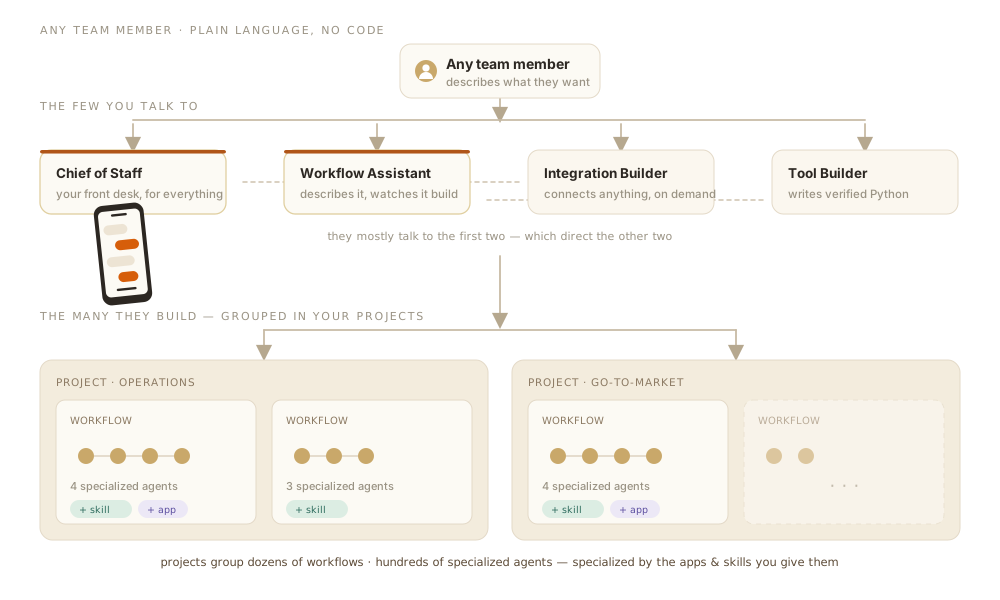
Anyone on your team talks to a few assistants, in plain language. They build and run everything underneath — the projects, the workflows, the agents that do the work, and the tools those agents need. And none of it needs you at a desk: your Chief of Staff is on your phone, answering in whatever app you already use.
Three tiers: anyone on the team, the few they talk to, and the many those build.
Most platforms answer every step with a model call — including the steps that were never ambiguous. Formatting a date. Routing on a status. Moving a field. It costs more, it takes longer, and it turns things that used to be certain into things that are usually right.
orqo puts each where it belongs. Work runs as stages — each with its own entry, main, and exit — so agents take the judgment and plain deterministic logic takes the rest, with a human gate wherever the decision has to be someone's.
Where you want judgment
Probabilistic agents
Reading, weighing, deciding, arguing it out with each other — the work that has no fixed procedure, and no single right answer to hard-code.
Where you want certainty
Deterministic logic
Scripts, rules, routing, and human gates that run the same way every time — because some steps must not be interpreted.
The canvas you actually build on: assignments feeding a stage — one carrying a skill, one a Finalizer that judges the result — with hook scripts in and out, and routing that sends the work back round when the outcome isn't good enough.
That loop is the pattern the whole field is converging on — something that produces, something else that judges, and another pass until the verdict changes. Almost everywhere it's implicit: a line in a prompt, or a loop in someone's script. Here it's declared, so you can see how many passes a result took and what each one cost.
Which is also why work reaches production here. Nearly nine in ten agent pilots never do, and the research is consistent about why: the failure is in the runtime, not the model. Inside the workflow engine
Preview is free — bring your own model keys and pay your provider directly.
Integrations
The integration no catalog has
Your business runs on systems no AI platform has heard of. Name one and orqo researches its API and builds the connector — two-way, so an event out there can start a workflow and a workflow can act straight back.
Every wire runs both ways — and the last tile is the point: name a system, and the connector gets built.
Connect a source or drop files in, and orqo ingests them on its own — classifying every document into a typed graph of 57 knowledge types and 48 typed relations, drawn from educational-science research. Nobody tags anything. Agents then navigate by meaning instead of guessing at the nearest match, and every agent works from that same memory — which stays when people leave.
Connect a source or drop files in. The graph builds itself — and every edge it draws carries a type, which is what lets an agent navigate instead of search.
Publish any graph as a chatbot or an MCP server, and decide which graphs may overlay. Inside the knowledge graph
Control
Your data, on infrastructure you choose
orqo is split-plane by design: the control plane holds none of your content, ever. The execution plane — where your data is actually processed — runs in orqo's cloud, in your own, or on hardware we deliver to your premises. Open protocols and your own model keys throughout, so nothing here locks you in.
The controls SOC 2 asks for — access, encryption, audit logging, data handling — are implemented today. The formal examination is on the roadmap, and the report gets published once it's complete. How the split plane works
Cost
Cheaper the more you run it
Most platforms cost more the more you use them. orqo compacts each agent's context continuously — not one catastrophic summary at the end — so the same budget does conservatively four times the work. Side conversations keep token-heavy exchanges off everyone else's bill, and every run informs the next.
The top bar ends where it started. The bottom bar ends at four times. That gap is the whole argument.
The sections above are the argument. This is the index — each capability, and where to read it in full.
How the work gets doneStages, hooks and gates that branch, loop and swarm — and every agent on the model that suits it, swappable mid-run on a normalized context. Read
IntegrationsTwo-way connectors built on demand for the systems no catalog carries, inbound triggers included. Read
Context managementCompaction per agent, continuously — not one catastrophic summary at the end. Read
Knowledge graphYour documents ingested into a typed graph agents navigate by meaning. Publish any graph as a chatbot or an MCP server. Read
Personal memoryAn assistant that knows you, private and separate from the company's. The company keeps the facts; you keep yourself. Read
Token economicsCheaper per result the more you run it, and every run charted so the spend is never a black box. Read
The agent standardThe four properties that have defined an intelligent agent since 1995 — and the one almost nobody attempts. Read
Finished documentsInvestor-grade reports and decks from a dedicated render engine — built to look as good as they read, not a wall of chat. Read
Get started
Claim your slot
Preview is free. You bring your own LLM keys — encrypted and injected at runtime — and pay your provider directly. Teams of humans and their agents, working as one organization. Questions, answered