AI for Beginners · Lesson 1

What it is

You don't need any mathematics, and you don't need to be "good with computers." Using a single, simple machine — one you could hold in your hands — we'll build the first piece of the picture: what a model is, and the prediction it lets us make. Get that, and the mystery gets a good deal smaller. That's the whole point.

CourseAI for Beginners
Lesson1 of 14
A small machine

Meet the coin board

There's an old wooden machine — sometimes called a Galton board. A flat board standing upright, with rows of little pegs, and a slot at the top. You drop coins in.

Each coin tumbles down, and every time it hits a peg it bounces — left or right, and you can't say which. It's pure chance. One coin drifts left; the next zig-zags its way to the middle. You genuinely cannot predict where any single coin will land.
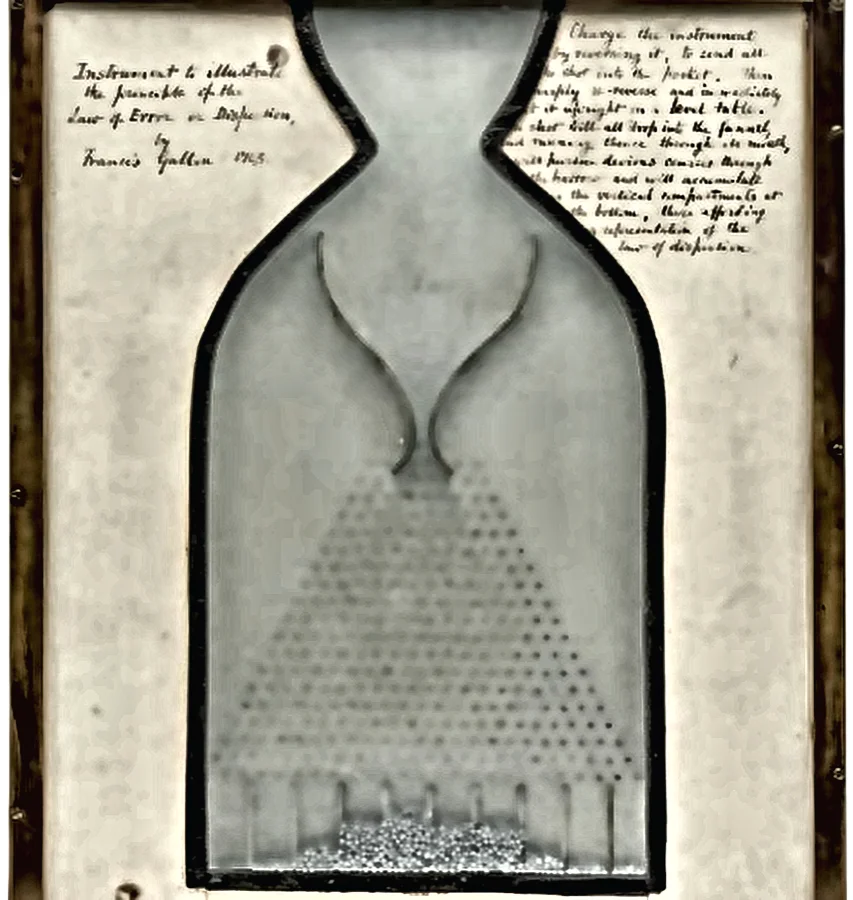
A photograph of Francis Galton's original 1873 quincunx, hand-labelled by Galton himself: 'Instrument to illustrate the principle of the Law of Error or Dispersion.' Rows of pins fill the triangular glass-fronted case, and shot has settled into a mound in the compartments at the bottom.
The real thing — Francis Galton's original 1873 instrument, labelled in his own hand. Same pins, same triangular field, same mound at the bottom, settled and waiting.

This is a real, 150-year-old device with a real history — read about where it came from →, if you're curious.

Drop a few hundred coins, and something happens that catches everyone by surprise the first time they see it.

The surprise

A shape appears — and nobody drew it

The coins pile into a smooth mound: tall in the middle, tapering at the edges. The same shape, every single time.

Nobody arranged the coins. No one told them where to go. Each one was random — yet together they form a shape you could predict with confidence. Randomness in the small; a reliable pattern in the large. That gap is where all of AI lives.

Don't take our word for it — pour some coins yourself and watch the mound take shape.

0 coins settled

The faint dashed line is the theoretical normal (Gaussian) curve the bins are converging toward. Nudge the bias slider and pour again — the shape survives, only its centre moves.

The one idea to take with you

One coin is a mystery; the pile is not. You can't say where a single coin will land — yet you can say, with confidence, the shape they'll make together. Randomness in the small, a reliable pattern in the large. Being able to call the shape without calling any one coin has a name we'll keep coming back to: a prediction.

Where the shape comes from

The shape is built into the board

Nobody arranged that mound — and yet it's no accident either. It comes entirely from the way the board is built.

The coin board as a diagram The same board drawn as a schematic: a coin enters at the top and bounces down through evenly spaced rows of pegs, each bounce an equal chance of left or right, collecting at the bottom in a mound that is tallest in the middle and tapers at the edges. ONE COIN IN THE SAME SHAPE, EVERY TIME
The same board as a diagram. Evenly spaced pegs, every pathway equally likely — and the mound that always results.

Look at a single peg. A coin hitting it has the same even chance of going left or right — a coin flip, fifty-fifty. And every peg on the board is exactly like every other: no pathway is favoured, none is wider or narrower than the rest. The board is perfectly even.

That evenness is the whole reason for the shape. Many different paths lead to the middle, so most coins end up there — the tall part of the pile. Only a rare run of bounces all the same way reaches the far edges, so few coins land there. Tall in the middle, tapering at the sides: that exact mound is simply the board's structure, made visible. Keep the board the same and you get the same shape, every single time.

One step further

Change the board, and you choose where the pile forms

So far the board had one way in, at the top, and the pile always gathered in the middle. But nothing says a board must be built that way. Picture a square one, with several ways in — say five slots across the top.

Now you decide where the coins go in. Put a funnel over the second slot and pour them all in there, and the pile forms under the second slot. Move the funnel to the fifth slot, and the pile forms over on the right instead. Same board, same pegs, same fifty-fifty bounces — only where you pour the coins in has changed, and with it, where they gather.

A square coin board, poured at two different slots The same square board is shown twice. On the left, a funnel over the second slot pours all the coins in there, and they collect in a mound beneath the second slot. On the right, the funnel is over the fifth slot, and the coins collect in the right-hand corner. Where the coins enter decides where they gather. 12345 FUNNEL ON SLOT 2 pile forms under slot 2 12345 FUNNEL ON SLOT 5 pile forms in the corner
The same square board, poured at two different slots. Pour the coins in at slot 2 and the pile forms under slot 2; pour them in at slot 5 and it gathers in the right corner. Where they go in shapes where they come out.

So the board no longer makes just one prediction. On this plain, even board a pile still forms straight below wherever you pour — but the outcome is now yours to move, simply by choosing the slot. That idea — where things go in shapes where they come out — is the one to carry into the next lesson.

Two things

So it's predictable, and it's fallible — both are normal

Two consequences fall straight out of the coin board. Knowing them puts you ahead of most people using AI today.

Consequence 01

It deals in likely, not certain

The pile as a whole is reliable; a single coin never is. Where any one coin ends up is only the likeliest spot — not a sure thing. Worth remembering the moment you start leaning on a single result.

Consequence 02

Sometimes a coin lands oddly

Once in a while a coin bounces the same way over and over and lands far out at the edge, nowhere near the middle. That isn't the board breaking — it's the very randomness that makes it work. Expect the odd outlier, and it stops being unsettling.

Your hand is on it

You are the one who drops the coin

The most important thing to know is also the most reassuring: nothing happens on its own.

The board just sits there. It does nothing until you drop a coin in — then it does its one job and goes still again. You can stop and walk away whenever you like. And using it changes nothing: it's the same board afterwards as before, the same for you as for everyone, every single time.

It waits for you You can stop any time It doesn't change as you use it
The whole picture

A model — and the prediction it makes

That's everything this page set out to give you, in two plain words. No mathematics, no science degree — just the board.

Word 01

The model

The board itself — the structure. Pegs and pathways in a fixed arrangement. On its own it simply channels whatever falls through it.

Word 02

The prediction

What the model lets you say in advance: pour the coins in and you know the shape they'll make — a bell curve, gathering under whichever slot you chose. The same result, every single time.

Next

Let's open the board up

Now that you have the picture, the next lesson opens the board up: what happens when the floor beneath the pegs is manipulated — so coins poured in at one slot can be carried to gather somewhere else entirely. That floor is where the real power hides, and the whole difference between one AI and another.

Lesson 1 of 14

Sign in to orqo

Choose how you'd like to continue.

More ways to sign in are on the way.